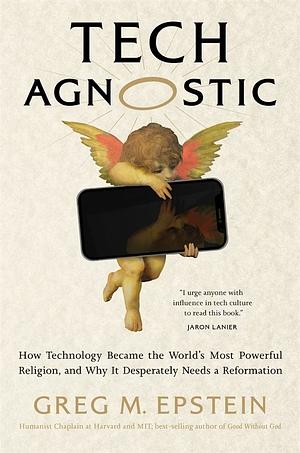
Tech Agnostic:
How Technology Became the World’s Most Powerful Religion, and Why It Desperately Needs a Reformation
by Greg Epstein
I always feel brave when I read non-fiction. I usually prefer something that takes me away from tech (my job!) and doesn’t mention the name of the company I work for (womp!). But in my ill-fated quest to better myself as a person and expand my mind, I decided to pick up Tech Agnostic. This felt like a natural expansion of my previous read (American Zion by Dr. Benjamin Park, the delightful book on the history of the LDS faith): Has tech become a religion in the modern age?
Before even reading it, my initial thought was yes of course tech is basically a religion. In the Bay Area, tech is life. Every party I go, someone whips out a laptop to push code. Every billboard advertises a new AI native solution to problem XX or YY or ZZ. Small talk consists of impending layoffs and Claude code. Tech is everything, everywhere, all at once (& by golly I’m doing my best to avoid it becoming my whole life).
Epstein’s book was more of an advertisement for humanism & optimism to me than a shocking answer to the question of tech as religion. He broadly agreed with my sentiments (or rather I with his): tech is religion in the modern age. We have CEOs who have become prophets, daily worship of your social media of choice, and promises of a transhuman future utopia (or heaven?) on the horizon. In Tech Agnostic, Epstein does a deep dive into this metaphor goes beyond it: how can reform tech? How can we make the world a better place to live in? This was an optimistic book that tackled some of the tough questions while encouraging the reader to think critically about their role in the world.
I’ll walk through my unstructured thoughts below:
I appreciate Epstein’s tone throughout Tech Agnostic: it isn’t a dry nonfiction book, but rather a collection of anecdotes & experiences & collected literatures. He keeps it fun and lighthearted, e.g.
In other words: technology has become religion. Am I speaking literally, or have I written this book to weave the most elaborate and annoying metaphor you’ll ever read in your entire life? Yes.
and then in the next paragraph he says the phrase “white-bearded, omnipotent sky daddies” referring to god[s]. His voice made the reading experience more pleasurable - this felt like a personal conversation between Greg & I about his experiences with social media addiction, the interesting friends he’s made in the tech space, and his work as a humanist chaplain.
The sections I found most interesting in Tech Agnostic were about effective altruism & Detroit Green Signal project. I have read about the lights extensively in grad school but also hey I lived through that! I remember when the gas stations all of the sudden had these blinking green lights. It always felt off to me that they would have ‘priority access to policing’; even as a child I felt like paying for preferential treatment from police was inherently wrong. But it is also a stark reminder of how class and race play into the surveillance state of the US and specifically Detroit. We can’t forget about Robert Williams, who was falsely arrested due to facial recognition technology mistaking him for another black man & the police department trusting their technology over his verified alibi. Our technologies capture the biases of the creators.
Effective altruism is another Bay Area-ism thing that people talk about all the time. “Oh haha I’m working at this grindy job that isn’t good for my health [but is for my ego] and isn’t beneficial for the world, but I can donate a shit ton at the end of the year”. Hmmmm…. sure. And how much do people end up donating? And what impact does it make? And why is it that you are the person who can change everything and make so much money and save the world? Why can’t you simply contribute…. now? I think sometimes ’touching grass’ or rather volunteering in your community will be more impactful. Not only to the community affected, but to yourself. There’s something important about taking the time, connecting with humans, and being part of a collective that makes you feel better. That’s what I love about volunteering - the act of being with others and working for something beyond ourselves. As an atheist, I have limited opportunities to be in such an environment! Effective altruism feels very egotistical in a strange way & I’ve yet to see it be impactful. If it truly is the best strategy to provide aid efficiently, how come all of these billionaire & millionaire effective altruists haven’t made a noticeable impact? I read the news [too] often… I would’ve seen something.
Other quotes I like:
We rarely stop to simply connect or to experience vulnerability. As a society, we dedicate ourselves to transcending… whatever it is that we currently are. Because what we are is never, ever, enough.
This reminded me of a conversation I had with my coworker about jobs, egos, and love. Why do we work where we do? Money, challenges, and probably a little bit ego. It’s why we care so much about promos and raises and TC. It’s why we have ‘weekend projects’ and Sunday night coding time. But many of the best parts of my life have come from being vulnerable & facing ego-death. I said something along the lines of “true love involves a lot of ego death” and I whole-heartedly believe that. I had severe stomach problems on my [then] boyfriend [now husband!] and I’s romantic trip to Hawaii. It felt like an ego death to ask him to get me medication & have him sitting 5 feet from the bathroom while I processed it. I felt incredibly embarrassed. But also so loved. It was hard for me to rely so much on Sam during my first year of graduate school where I didn’t even have a part time job my first semester (that was a financial net negative few months for me). Yet it enabled me to get the job I have now and devote myself fully to my studies. And I know he will always support me, even if it feels embarrassing or shameful. That is such a freeing and affirming feeling: to be loved when you are not proud of yourself, to be loved when you feel you don’t deserve it. I have had the same experiences with my friendships too: being vulnerable (whether by just going to meet new people, inviting casual coworkers to be closer friends, or opening up about awkward things) enriches relationships. Sometimes I think we spend too much time optimizing our lives and growing and bettering ourselves when we could just be happy with people we care about. This is something I struggle with greatly.
… so many of the world’s most talented people – people like me, who got to be so talented less by being born better and more by being lucky enough to soak up disproportionate amounts of the resources, love, nuturing, and education in their communities (and indeed in the world) – will spend most of their energy striving. We say, and we are told, that all the striving is for the betterment of humankind, to “change the world.” But sometimes the change we end up facilitating is in our own worlds, as we gain money, convenience, and esteem for work that again and again leaves more than half the globe’s population undernourished, under-resourced, and afraid for the future.
So many of us Ivy League, Top 10 University folks come out of university with the goal of changing the world for the better. And undoubtedly some do! But am I doing so in my current job? I’d like to think that in some sense yes - integrity teams truly believe in improving the state of the platform for users. But it’s still working at a private company, that profits from said users. I’ve been thinking a lot of the quote from Ann Leckie’s Ancillary Justice (guys I’m always thinking about Ann Leckie’s books I love them) that is something along the lines of “Civilization and luxury always come at the expense of someone else… but those someone elses are planets away”. The same is true for us: our luxuries and convenience and prestigious work does come at a cost we don’t pay. It comes at the cost of the people who make the shitty things we order on Temu and then give away, the children who work in electronics manufacturing, the people who experience genuine harms. I am only where I am due to the lucky accident of birth. What should I strive for? How can I make the world a better place? Should I be afraid for the future? I think so. But do I still deeply yearn and believe in the Star Trek like utopia, of exploration and equity, of the eradication of poverty and ability to devote your life to art and science? Yes. Epstein notes that “The tech apocalypse is already here: it’s just unevenly distributed. We need to start acting like the worst could happen to us, unless we work for equity and think about how all might benefit from doing so”. The future is now & we live in it. We can change it.
Tech humanists approach tech with a single purpose in mind: to improve our individual and collective aptitude for building a loving world. We judge our creations by that standard alone.
And then the book pivots to quotes like this and I don’t feel so bad. Maybe we will improve the world. Maybe everything will be solarpunk Star Trek and not cyberpunk. I don’t know! But I do know that I work with and am friends with good people, who want a good future and not a bad one. Epstein emphasizes the importance of finding a community of good people in tech & I do believe I found one - my wonderful genius friends from UofM, many of whom have incredible jobs in Detroit that directly work to better the city, my integrity coworkers who really do care about doing the right things and changing the system from the inside, my fellow Cornellians who work outside of tech but run animal rescues (check out Praline’s Promise) and do incredible research. I hope that we can do it.
Except Raahul really wants the slightly apocalyptic future. He really wants Cyberpunk 2077 IRL. He needs that cybernetic appendix.