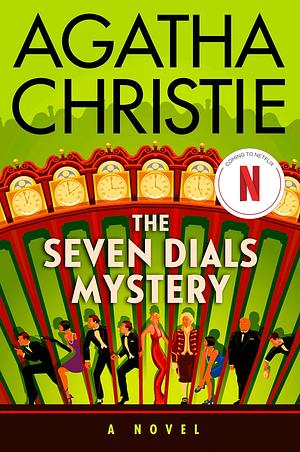
The Seven Dials Mystery by Agatha Christie
It has been years since I picked up an Agatha Christie mystery. The last time was in my sophomore year of high school, when we read And Then There Were None (or rather the older and more offensively-titled edition). I have sated my desire for whodunits with cozy mystery novels of varying quality and David Suchet’s Hercule Poirot series. In a recent downtrodden and lonely mood, I’ve been watching a Poirot every night, to stave off the horrors. This led to my streaming service of choice recommending me the 1981 film Seven Dials Mystery. A friend from work had recently told me it was his favorite Agatha Christie novel (yes, in classic data scientist fashion I did an ad-hoc survey of whether all of my coworkers were familiar with Christie and Poirot). When in Utah, my littlest sister in law, father in law, and started the 2026 Netflix Agatha Christie’s Seven Dials series. I was immediately struck by the difference between the two adaptions and thought: I better read the book.
And read I did! With the help of my handy dandy public library, I had a copy available within 3 days. I inhaled The Seven Dials Mystery like it was my first breath of air on a perfect fall day. We have an intrepid young woman - Lady Eileen, AKA Bundle - a series of loveable oafs, and a competent young man inexplicably called Pongo. Christie is truly the master of the whodunit - sharply witty dialogue, misdirection, and an ending I never would have guessed in a million years! As the introduction states, this novel has everything needed for a classic early 20th century novel: a secret society, a manor house in a beautiful English countryside, and tension between the nouveau-riche and aristocracy.
Read this for a time-capsule of the 1920s, thrilling robberies, unexpected proposals (how are people in the Christie novels always getting engaged at the drop of a hat?), and a happy ending.