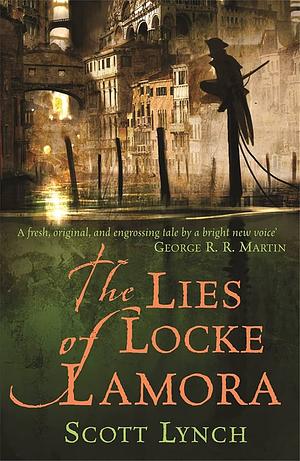
The Lies of Locke Lamora by Scott Lynch
Before I even begin the review, I have a story. 3 years ago, Sam’s friend recommended that I read The Lies of Locke Lamora. I love to take a recommendation, so I gladly went to my public library and put it on hold. The next day, I saw the notification switch to “In Transit”. A week goes by. Still “In Transit”. My library system is not that big. I go to the front desk and ask what happened to the book. It was lost. They lost the book. It took years before they either a) found it or b) purchased a new copy.
Ironically, I actually bought a copy of this book for $1 at the same public library’s Friends of the Library book store, 3 years later.
The Lies of Locke Lamora was well-worth the wait. We enter the city of Camorr, a city (that I imagine to be beaux-arts) divided by wealth: the luxury upper-class partying on elevated islands while the organized underbelly fights to eat. Then we have the Gentleman Bastards, who walk the tightrope in-between the two. Stealing from the rich, pretending to be poor, cooking elaborate fanciful meals and living as family. Lynch’s writing is atmospheric and enchanting - you quickly become enraptured with Camorr. It’s like a mix of Venice and Paris to me, with a few additional fantastical elements.
Jean was my favorite character: I love his arc with the death god, his time spent in the chapel and coming close to dying. Maybe he is truly touched or favored by the god! I also think Locke is a bit of a stereotypical character: an audacious young and overly confident young man with more ambition than commonsense. Jean is different - the protector, the accountant. He may seem less interesting or volatile - but he rages like sun.
What really shines in this book are relationships: Locke and Jean, Locke and Chains, Locke and Bug. I feel their love through the pages. If I had one single complaint, it would be that this was clearly a set up for more. I will most certainly read the sequel! I’m curious to see if more magic will come up in the further novels - it is constantly hinted at, but not fully explored.