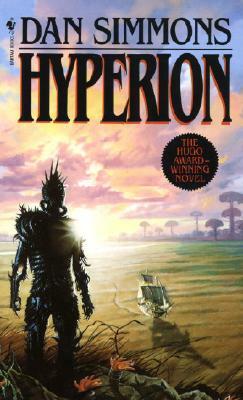
Hyperion by Dan Simmons
Hyperion… the book that has been staring at me from my book shelf every day…. the name of one of my favorite coffee shops in Ann Arbor (you’re still number 1, Dozer)… I have finally read you!
Ever since I saw the cover in the downtown A2 coffee shop, I had been casually interested in reading Hyperion. It’s a classic scifi book, adorned with a cover of sunset colors that depicts an evocative armored man and great ship sailing a grass sea. Yet… my reading list is long! My reading time is more limited, now that I’m fully employed (booo but also… thanks for not laying me off). It never happened. Then! Sam & I, the modern-day hunter gatherers that we are, discovered a copy of Hyperion (the exact same edition I had gazed upon in A2) and its sequel at the Foster City Friend of the Library book shop. For the price of $2, we acquired our prizes and placed them front & center on our crowded bookshelf. And there it sat.
After months! Sam himself broke the ice. He read Hyperion & then I picked it up afterwards. God, I shouldn’t have waited so long.
Hyperion is a novel that gives meaning to the genre of ’literary science-fiction’. Simmons has the prescient imagination that we can look back on and say how did he know it would be like that? His descriptions of the web (the Internet was very much in its early days when this book was published in 1989), the AIs (sharing content regardless of copyright cough cough OpenAI), & the death of literature (very much reminiscent of the discourse online about the romantasy craze & its impact on publishing) were prophetic.
I love Simmon’s structure: it’s very cinematic. We learn about a set of 7 pilgrims, on a journey to a deadly temple, and the stories that have motivated their selection in the pilgrimage. This allows the author to switch genres with ease: the atmospheric horror of Father Hoyt, strange romance of the Consul, noir mystery of M. Lamia, tragedy of Sol, the epic poem of Silenus, and action movie (with both kinds of action) of Kassad. Each story is woven together with a few common threads: the Shrike, the outback colony of Hyperion, and heartbreak. The overarching mysteries - Who is the Shrike? What’s inside the time tombs? - keep me wanting more. I’m looking forward for the next novel in Cantos and continue to unravel the mysteries.
Silenus’s story details many fascinating ideas about the future of publishing:
In the beginning there was the Word. Then came the fucking word processor. Then came the thought processor. Then came the death of literature. And so it goes.
This line was so evocative that Sam showed it to me as he read it the first time. In our AI-pilled modern technocracy, LLMs are the thought processors. Every idea and response is filtered through Chat-GPT or Claude or Muse Spark before sharing or creating. Children learn to think with the companion of an AI-Assistant. Simmon’s foretold this future.
Though honestly, Silenus’s story was my least favorite (I’m not one for all this self-interested prose and references I don’t fully understand), there were some good quotes:
I was twenty-two before I realized that computers, RMUs, and Uncle Kowa’s asteroidal life-support devices were machines and not some benevolent manifestations of the animas around us. I believed in fairies, woodsprites, numerology, astrology, and the magic of Midsummer’s Eve deep in the primitive forests of the NAP.
This reminds me to think of how incredible our technology is, how magical it may all seem. It almost makes me think of Mercedes Lackey’s fantasy world of Valdemar: where wind sprites and creatures powerful mechanisms, like machines. Without knowing what we know, would we not think the same? Our LEDS are fairy lights, planes are eldritch beasts, microwaves casting spells.
This line about Maui-Covenant reminded me of how the same the eighties were to today:
Nobody gets beyond a petroleum economy. Not while there’s petroleum there.
Power will always seek oil, at any cost, even human lives.
My one word of warning: there are a lot of references to Keats (& other pieces of literature that I’m sure I missed). I don’t know Keats at all. I barely caught a few of the references (Shakespeare, Reichenbach Falls). Sometimes they feel a little trite (at one point they sing along to “We’re off to see the Wizard! The Wonderful Wizard of Oz!). Read Hyperion at your own risk of literary ignorance!!
EDIT - only after reading other reviews did I realize that this was a retelling of The Canterbury Tales. I clearly missed a lot of references. Sorry to every english major in the world, I need to read more classics!