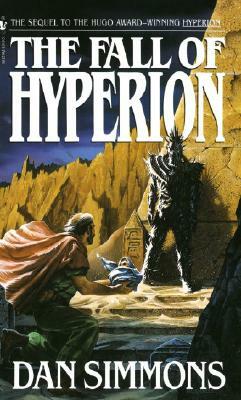
The Fall of Hyperion by Dan Simmons
My curiosity could not be sated, I had to immediately start The Fall of Hyperion after finishing Hyperion. Dan Simmons is a master at creating mysteries that I must unravel. We end Hyperion on the brink of war: the Hegemony vs the Ousters. The fates of our pilgrims are unknown: Will the Time Tombs finally open? Will Rachel live? What will happen to Father Hoyt’s two cruciforms? Who is Moneta? Will Johnny escape from his loop in Brawne’s mind? Where is the Core? Why did they replicate Old Earth?
I was a bit surprised by the change in style: no more short stories! Back the traditional-novel mode of storytelling. My favorite stylistic moment (which will surprise those who know my taste) was the poetry spoken by Ummon. As Sam said, “I love a cryptic ominous speech”. There’s something fun about trying to decode out the hints and predictions. Maybe the Swifties are on to something, idk.
The Fall of Hyperion continues to be prescient, just as Hyperion was! This book discussed the relationship with AI + Humanity + God (relevant after Anthropic’s IPO) & all of the permutations of k=2. It’s an exploration of empathy and faith and love, of our obligation as people. How much should we rely on technology we don’t understand? What is the role of empathy in an uncertain world?
Simmons touches on this topic, in the context of AGI:
“But would a true God extinguish his creatures?”
“In the case of the Core and the hypothetical UI,” I said, “God is the creature, not the creator. Perhaps a god must create the lesser beings in contact with it in order for it to feel any responsibility for them.”
Would AGI be a God? Simmons/Severn cybrid thinks it could be. The question is: what would God’s relationship to humans be? The Fall of Hyperion explores this question through multiple lenses: the god of the Core sees no need for humans (aside from some extra compute to be stored in the labyrinths for a rainy day) and no need for the AIs who will create him. It will cannibalize the Core, even the AIs who didn’t follow him. The God of Humans, which may be created by our infinite capacity for love and care in an often cruel world, has empathy and responsibility to the pain and suffering of others. Which God do we think is more likely? Which one would AGI be?
“There was no welcome from a heavenly Father… No reassurance that the pain and sacrifice had been worth anything. Only pain. Pain and darkness and then pain again.”
…“And that made you lose your faith?”
…“On the contrary, it made me feel that faith is all the more essential. Pain and darkness have been our lot since the Fall of Man. But there must be some hope that we can rise to a higher level … that consciousness can evolve to a plane more benevolent than its counterpart of a universes hardwired to indifference.”
I’ve read a lot about faith in this past year. I feel very distanced and unconnected from a god who will look at my suffering in the face and deem it natural, from a god who leaves prayers unanswered, from a god who’s book explicitly deems women as lesser. Durés’ faith, based on hope and empathy and love, resonates deeply with me. The humanist side of this future-pope is compelling: we can have faith in a beautiful part of the universe. When life is so hard and suffering so abundant, maybe we can create a loving God simply by believing in him.
The AIs are worse. Brawne feels less than insignificant in their shadow: insignificance might offer invisibility; she feels all too visible, all too much a part of these shapeless giants’ terrible perceptions…
Damn sometimes I feel like this. Too visible in ways and places I don’t want to be.
Yet somehow Theo knew at once that these were human beings, as shocking as their differences were. Their attentive gazes, their relaxed postures, and a hundred other subtle human attributes - down to the way a butterfly-winged mother cradled a butterfly-winged child in her arms - all gave testimony to a common humanity which Theo could not deny.
Empathy is one of the main themes in the book, the emotion that defines The Fall of Hyperion. Theo found empathy for his enemy, the Ousters, due to their innate humanity. Seeing them out of their warships, in their homes, untainted by the Core changes his perspective. In this moment, Theo experiences a spark of divinity (empathy!) despite the indifference of the universe.
We are created for precisely this sort of suffering. In the end, it is all we are, these limpid tide pools of self-consciousness between crashing waves of pain. We are destined and designed to bear our pain with us, hugging it tight to our bellies like the young Spartan thief hiding a wolf cub so it can eat away our insides.
I was incredibly moved by Simmons’ descriptions of Keats/Severn cybrid’s suffering. He wrote about the daily experiences, looking at the light while coughing, hearing a companion sleeping in the other room, the human moments of pain. But what can people do in these moments but suffer? We have no choice. We are constantly hurtling through new experiences and suffering, over and over again.
“… The Core offered unity in unwitting subservience… Safety in stagnation. Where are the revolutions in human thought and culture and action since the Hegira?”
“Terraformed into pale clones of Old Earth… Our new age of human expansion will terraform nothing. We will revel in hardships and welcome strangeness. We will not make the universe adapt… we shall adapt”
“If humankind survives this test, our future lies in the dark distances between as well as on sunlit worlds”.
This is my boomer fear of new AI tools and overly personalized, optimized lives. We need friction. We need hardships and struggles. We should be flexible and adaptable. We need to be hungry and learn. I don’t think we need to suffer, but I worry that without challenges we (at least myself), will lose my ability to grow and change and evolve. I want to learn and stretch and evolve. In the moments of my life that are uncomfortable, the experiences that are challenging and novel, I end up having the most fun! Doing hard things is good for us.
The people complained to each other, thanked God for deliverance, argued with God about the discomfort of that same deliverance, and went about their business.
This is the nature of many apocalypses, in my opinion & experience. Life goes on! People are people and the minutiae and monotony of life must continue as much as humanity does.
… love was as hardwired into the structure of the universe as gravity and matter/antimatter. There was room for some sort of God not in the web between the walls, nor in the singularity cracks in the pavement, nor somewhere out before and beyond the sphere of things… but in the very warp and woof of things. Evolving as the universe evolved. Learning as the learning able part of the universe learned. Loving as humankind loved.
This was the crux of the novel. Sol’s epiphany changes the nature of humanity’s relationship with the Abrahamic God. God was chosen by Abraham. If God had let him kill his son, Abraham would not have accepted God as his deity. It was not Abraham’s test, but God’s. God is made of love, God evolved from love. This is a kinder version of the universe, a more empathetic and compassionate view of God than the one I know. I’m glad for Simmons for making me think and dream and ponder about what a god that evolved from my ability to love would be like.
Note: I was able to predict two of the mysteries/questions I posed above: Rachel being Moneta and the Core living in the Web/Farcasters. I read some (sorry cringe) reddit post about reading comprehension declining in the time of AI. I was then paranoid that my reading comprehension was declining, after reading so many tasty & crunchable scifi fantasy books. But! Reading a slightly more challenging book & being able to guess a few of the mysteries made me feel a bit better about myself. Maybe I should read more classics.
MY ONLY COMPLAINT: Stop referencing the Wizard of Oz. It’s weird!! It’s out of place!! Seriously!